I became a father in April 2020, a couple of weeks into the UK’s first lockdown of the COVID-19 pandemic. I found myself not only dealing with challenges of being a new parent for the first time, but had to do so while holding down a job during the chaos and uncertainty.
This led to a severe decline in my mental health and, ultimately, to burnout and an anxiety attack. Which then became my motivation for starting the ConveRSE project.
Parenting on Hard Mode
Fortunately, I was able to be there for the birth of my son, but then I had to leave them both in the hospital to recover, meaning I didn’t get to see him for the first two days of his little life. When I did bring them home, we had to learn how to be parents without any outside support. They say “it takes a village to raise a child”, but we were very much on our own.
I wrote about our experiences on my blog, starting from the day we found out my wife was pregnant until my son’s first birthday. It was meant to be a light-hearted but frank and honest account of my experience of becoming a father, but it became something more. I kept going with the blog throughout everything that happened, and you can read the full story on my website.
Note: this is a raw and unfiltered blog that from the beginning -and more so as the pandemic hit - contains some not-entirely-safe-for-work language!
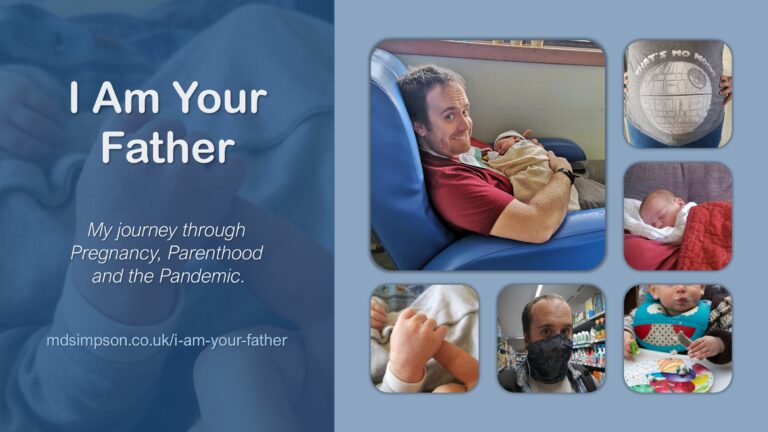
The first few weeks were particularly chaotic, as I had to look after my wife - who had developed mastitis and anaemia - and my son - who had acquired a broken collarbone during his ‘dramatic arrival’. We managed to survive that difficult period, but then I had to return to work (from home) and pressures continued to mount. I had to keep two PIs and my boss happy, all while looking after my wife and son, while we were all trying to get to grips with “the new normal”.
It wasn’t long before I was burnt out. But it wasn’t like I could step back from any of my responsibilities. There was very little support and everyone was struggling, and I didn’t want to bea burden to anyone else. I carried on as best I could, but I was mentally and physically exhausted, and eventually I reached breaking point. The resulting anxiety attack meant I had to take a chunk of time off work and give up all my other responsibilities. It took me a long time, a lot of hard work and a lot of expensive therapy, to recover physically, mentally and professionally.
It is one of the hardest things I’ve been through in my life, and something that its difficult for me to talk about, even now.
So, why am I talking about it?
I wanted to share my story, because I think it’s important to break down the stigma around mental health. Also, even though most of what happened was nobody’s fault - everyone did the best they could in difficult circumstances - I think there are things we can learn from my experience, and the experiences of others. I hope that by sharing those experiences, we can reduce the chances of anyone else having to go through what I went through.
I’ve also learned that “it’s better to raise a red flag before you are forced to wave a white one” - by discussing issues early, we can intervene to help stop them from becoming larger problems. And this has become one of the key messages of the ConveRSE project.
SSI Fellowship
And so, in 2024, I applied for the SSI fellowship. It was my goal to build upon the work of my colleague Dave Horsfall,and other fellows, who have done such excellent work in this area already. I wanted to turn my experience into something positive to benefit the Research Software Engineering community.
The Software Sustainability Institute team have been incredibly supportive throughout this process. Check out their website and sign up to their mailing list for more information about the fellowship programme.
Final Thoughts
So, that’s what ConveRSE is all about; continuing the conversation around mental health, helping people realise that they are not alone, and sharing resources, advice and support to help us look after ourselves and each other. I’m eternally grateful to the SSI for giving me the opportunity (and the cold hard cash!) to do this important work.
I hope that by sharing my story, I can encourage others to do the same, and that by creating a community and keeping the conversation going, we can make a real difference to the mental health of Research Software Engineers and the wider dRTP community.
If you’d like to get involved, check out the Get Involved and Contribute pages.
Thanks for reading.
Take care of yourselves.